Korean Drinking Etiquette:
Toasts, Pouring and Elders
Korean drinking etiquette comes down to one idea: showing respect to people older or more senior than you. That is why Koreans pour and receive with two hands for an elder, turn slightly away to drink in front of them, hold their glass a little lower in a toast, and never pour their own drink. Between friends of the same age, most of this relaxes, and nobody should ever be pushed to drink.
I am Korean, and I run three Korean bars in Higashi-Shinsaibashi, Osaka. Guests often tell me they saw these gestures in a K-drama and never knew what they meant. So here is each custom, how to do it, and the reason behind it, so you know what is going on at the table, in Korea or in Japan.
.webp)
The customs, and the reasons behind them
Almost every rule at a Korean table grows from the same root: respect for elders and seniors, which is often explained as an influence of Confucianism. Age and position matter, so the person you are drinking with decides how formal you need to be. A word of honesty first: these customs vary by generation, workplace and who you are with, and these days many Koreans keep things relaxed. Think of what follows as the polite default, not a test you can fail.
| Custom | How to do it | Why |
|---|---|---|
| Two hands for elders | Hold the bottle or glass in one hand and rest the other hand on it (or support your arm) when you pour for, or receive from, someone older | It is a way of showing respect to someone older. With friends your own age, one hand is normal |
| Turn away to drink | In front of an elder, turn your face and body a little to the side as you drink | Not drinking face-on in front of them is a quiet sign of respect |
| Glass a little lower | When you clink glasses with someone senior, touch the rim of yours slightly below theirs | The lower glass shows deference to the older person |
| Do not pour your own | Pour for each other; when someone’s glass is empty, fill it | At a Korean table, you look after each other’s glasses rather than your own |
| Wait until it is empty | Many people avoid topping up a glass that still has a drink in it (this is called cheomjan) and pour once it is empty | It is often said that adding to a cup is a gesture from ancestral memorial rites (jesa), so people avoid it in everyday drinking |
Two hands: what it actually looks like
You do not need a perfect technique. Pouring for an elder, hold the bottle in your right hand and lightly touch your right forearm or the bottle with your left. Receiving, hold your glass with one hand and support it with the other. That small extra hand is the whole gesture.
Turning away: how far?
Just a slight turn of the face or body. It is a small, natural movement, not a full turn of the chair. If you are drinking with friends, there is no need to do it at all.
Watching other people’s glasses
Because you do not pour for yourself, the table works only if everyone keeps an eye on everyone else. If you notice an empty glass, offer to fill it.
How to toast in Korean: geonbae, jjan and wihayeo
| Korean | Say it | When to use it |
|---|---|---|
| 건배 | geonbae (gun-bae) | “Cheers”, written with the same characters as the Japanese kanpai. Works anywhere |
| 짠 | jjan | The sound of glasses clinking. Casual and friendly, the one you will hear most among friends |
| 위하여 | wihayeo (wee-ha-yo) | “For …!” One person leads with a line, and everyone answers together with wihayeo |
Wihayeo is the group toast. The person leading the toast says what it is for, and the whole table shouts the answer at once. If you are new to it, just watch the first round and join the second. For common questions about visiting a Korean bar, see our Korean bar FAQ, and for the drinks themselves, Soju 101. The games that often follow a toast are in Korean drinking games.
Korea vs Japan: the same table, different habits
If you are drinking in Japan with Korean friends, or in Korea after a trip to Japan, the two sets of manners look similar but differ in the details. Both vary by setting, so take this as a general picture.
| Situation | Korea | Japan |
|---|---|---|
| Pouring for others | Yes, with two hands for elders | Yes, pouring for others (oshaku) is common too |
| Topping up a glass that is not empty | Many people avoid it and wait until the glass is empty | Common; people often refill before the glass is empty |
| Pouring your own drink | Usually avoided; you pour for each other | Normal at casual gatherings (called tejaku) |
| Turning away to drink in front of elders | A common sign of respect | Not a usual custom, and not rude to skip |
| Drinking before the toast | Wait for the toast | Do not start before everyone has a drink and says kanpai |
Some people in Japan also like the beer label to face up when you pour, a small courtesy rather than a rule. Izakaya in Japan may also bring a small starter you did not order; see what otoshi is. For the wider picture of drinking out in Japan, read Osaka bar etiquette.
Drink at your own pace, and stay safe
If you cannot drink, or do not want to
Traditionally, the first glass offered by an elder was something you accepted. That view is changing: if you do not drink, you do not have to. Accepting the glass and just touching it to your lips, or toasting with a soft drink, is increasingly seen as fine. A simple, friendly “I do not drink, but cheers!” is enough.
No forced shots
Do not push anyone to down a drink in one go, and do not let anyone push you. Good drinking etiquette in any country includes respecting a “no”.
Two laws to know in Japan
- Under 20: no alcohol. In Japan, drinking under the age of 20 is prohibited by law, and businesses that serve alcohol are required to take steps such as checking age. Our bars do not admit anyone under 20.
- Drink-driving. Under Article 65 of Japan’s Road Traffic Act, it is prohibited to serve alcohol to, or encourage drinking by, someone who may drive; to lend a vehicle to someone who has been drinking; and to ask for a ride from a driver you know has been drinking. Since November 2024 this also applies to riding a bicycle after drinking.
Try a Korean-style toast at our bars in Shinsaibashi
Our three bars are all in Higashi-Shinsaibashi, Osaka, with Korean staff, K-pop and Korean drinks. Try saying geonbae or jjan to the Korean staff and clinking the Korean way; just start the conversation. All three are bars, not Korean restaurants, and do not serve food. Each is rated 4.9 on Google Maps: HEAVEN with 2,844 reviews, 韓国バーMOON with 380 and SARANG with 678 (as of September 2026).
| Bar | Best for | What it is like |
|---|---|---|
| HEAVEN | Singing | Free karaoke and darts, plus a VIP room. Smoking allowed |
| 韓国バーMOON | Sitting down to talk | Shisha and lounge seats. Smoking allowed |
| SARANG | A quiet drink, even alone | A quiet bar that is fully non-smoking, with no karaoke and mostly counter seats; easy to drink alone |
- Open every day from 21:00 to 05:00, no closing day, no reservation needed.
- You can ask questions before you come by phone or Instagram DM. If you do not drink alcohol, please ask the bar in advance.
- Credit cards and cash are both accepted. Private hire and groups are possible; please ask the bar about numbers.
- HEAVEN and 韓国バーMOON allow smoking inside; SARANG is fully non-smoking (see smoking in Osaka bars).
- Guests under 20 cannot enter.
Coming on your own? See solo drinking in Osaka. New to Japanese bar words? Try the Japan nightlife glossary. Not sure which bar suits you? See the quick guide by purpose.
HEAVEN
Free karaoke and darts, plus a VIP room, for a night of singing and toasting together.
5F Galaxy Building No.3, 2-4-19 Higashi-Shinsaibashi, Chuo-ku, Osaka
Open in Google MapsMOON
A Korean bar with shisha and lounge seats, for sitting down and talking over a drink.
3F LUXE Building Naka Room, 2-8-6 Higashi-Shinsaibashi, Chuo-ku, Osaka
Open in Google MapsSARANG
Fully non-smoking. A quiet bar with no karaoke and mostly counter seats, easy to visit alone.
Room 206, Gold Center Building, 2-8-12 Higashi-Shinsaibashi, Chuo-ku, Osaka
Open in Google Maps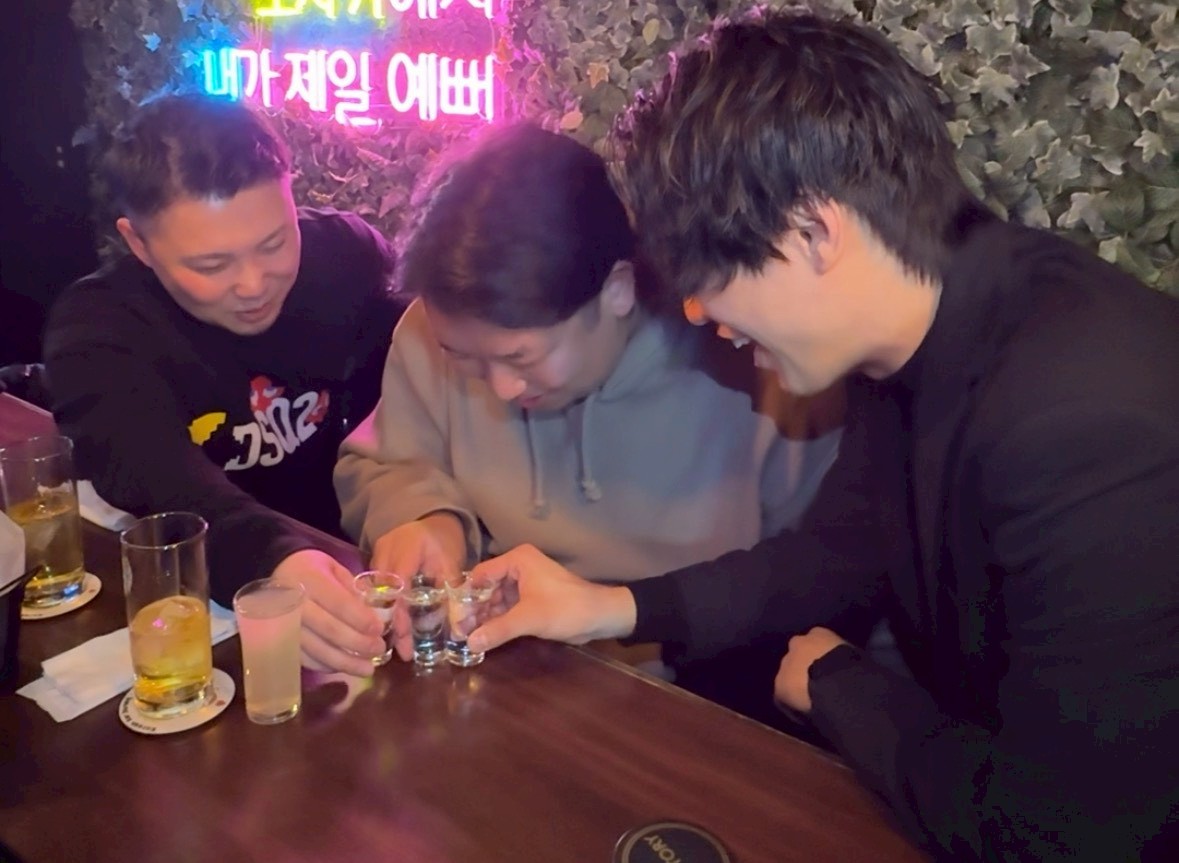
FAQ
Q. Is it rude not to turn away when I drink?
Not with friends. It is a sign of respect toward someone older or more senior, and how much people expect it varies by generation and setting. Doing it is a nice touch, not a test.
Q. Should foreigners pour with two hands too?
It is appreciated when you pour for, or receive from, an elder. With people your own age, one hand is fine.
Q. What if I do not drink alcohol?
You do not have to. Accept the glass and touch it to your lips, or toast with a soft drink. Nobody should force you to drink.
Q. How do you say cheers in Korean?
Geonbae (건배) is the standard word, jjan (짠) is the casual clink, and wihayeo (위하여) is the group answer to a toast.
Q. Is it OK to top up a glass in Japan?
Yes. In Japan refilling before the glass is empty is common, and pouring your own drink is normal at casual gatherings. Many Koreans prefer to wait until the glass is empty.
Q. Can I pour my own drink at a Korean table?
The custom is to pour for each other rather than for yourself. When someone’s glass is empty, fill it, and they will do the same for you.
Q. Do your Korean bars serve food?
No. All three are bars, not Korean restaurants, and do not serve food. Please eat before you come.
Sources (checked on 12 October 2026): Tokyo Metropolitan Police Department, “飲酒運転の罰則等” (Road Traffic Act, Article 65); Act on Prohibition of Drinking by Persons Under 20 (二十歳未満ノ者ノ飲酒ノ禁止ニ関スル法律). Korean and Japanese drinking customs are described in general terms and vary by generation, region and who you are with. Bar information is from Google Maps (as of September 2026).