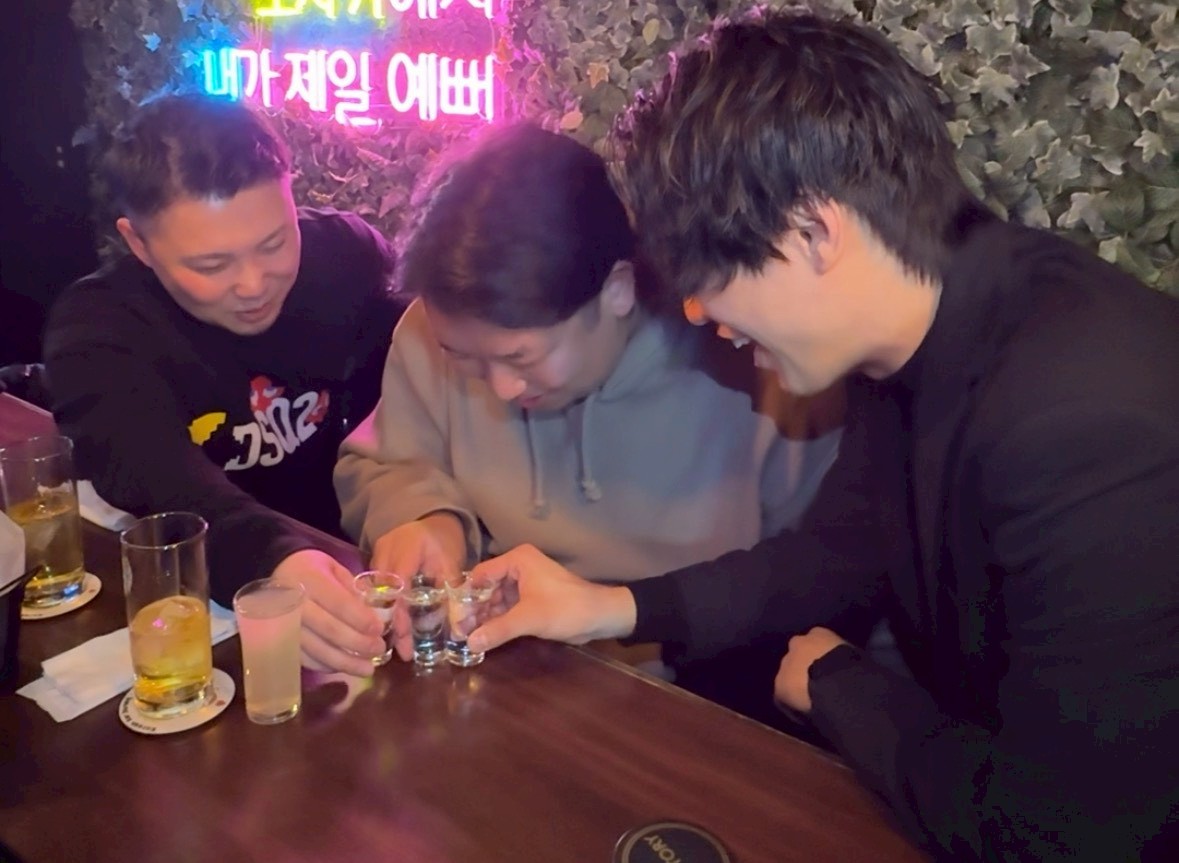
Korean Drinking Games You'll Actually Play
369, Bunny Bunny and the APT. Game
Hello. I am a Korean owner running three Korean bars — HEAVEN, MOON and SARANG — in Higashi-Shinsaibashi, in the middle of Osaka's Minami district. Almost every week someone at the counter says the same thing: "I've seen this in a K-drama, but I have no idea what they're actually saying." The clapping, the rabbit hands, the chant that turns into a group meltdown. In Korean these are called sul-geim (술게임) — literally "alcohol games" — and they are the fastest icebreaker I know of between people who have just met. This page is the version I wish existed in English: five games, exactly what you say out loud, what counts as losing, and the one rule that matters more than any of them.
.webp)
What a "sul-geim" actually is — and what it isn't
The structure is always the same. Everyone sits around the table. A rhythm or a turn order starts. Somebody breaks it — wrong number, wrong beat, too slow — and that person takes the penalty. Traditionally the penalty is a sip.
Here is the part that surprises most visitors: the point was never the drinking. The point is that ten minutes ago you were eight strangers staring at your phones, and now you are all shouting at the same person for clapping on 14. That is the entire function. Koreans play these at university clubs, at company dinners, at family gatherings, and on variety shows — and increasingly they play them with the penalty softened to a sip of cola, a bad impression of somebody, or nothing at all.
No equipment. No app. No shared vocabulary needed beyond about four words. If you learn two of these games you can walk into any table in Korea — or into our bars in Osaka — and be part of it inside a minute.
1. The 369 game (sam-yuk-gu / 삼육구)
This is the one you have definitely seen. It is the entry-level game and it is deceptively brutal.
- How it runs. Go around the table counting up: one, two, three, four… but any number containing a 3, 6 or 9 is never spoken. You clap instead.
- The trap. It is not multiples of three — it is the digits. So 13, 23, 30, 31, 32 all get a clap. And 36 contains two of them, which at most tables means two claps.
- You lose if you say a number that should have been a clap, clap on a number that shouldn't have been, or hesitate long enough that the rhythm dies.
- Hard mode. Count in Korean — il, i, sam, sa, o, yuk, chil, pal, gu, sip (일・이・삼・사・오・육・칠・팔・구・십). Most people collapse around 13. This is also, accidentally, the most efficient Korean numbers lesson ever invented.
Start at a slow, steady tempo and let it accelerate naturally. The game is only fun once it is faster than everyone's brain.
2. Bunny Bunny (ba-ni ba-ni / 바니바니)
The one with the hands. Loud, physical, and impossible to play while looking cool — which is exactly why it works.
- The starting position. Both hands up beside your face, flapping like rabbit ears or a rabbit's mouth, while you chant "ba-ni ba-ni" on the beat.
- Passing it on. Without breaking the rhythm, you throw it to someone: "ba-ni ba-ni" aimed straight at them. They must immediately pick up the same chant and the same hands.
- The neighbours' job. Here is what nobody explains in the clips. The two people sitting either side of whoever is currently the bunny have to chant "dang-geun dang-geun" (당근당근) — "carrot carrot" — while shaking their hands. Every single time it moves.
- You lose if you miss that you were named, forget you are now a neighbour, or break the beat. In practice everyone loses by forgetting they are a carrot.
Four words total: bunny and carrot, twice each. It travels across a language barrier better than almost anything else at the table.
3. The five-finger game (Son Byung-ho game / 손병호 게임)
Named after the Korean actor Son Byung-ho, and the one that quietly turns into a conversation. If you only learn one game from this page, learn this one — it needs no rhythm, no counting and no pronunciation.
- Setup. Everyone holds up one hand, five fingers extended.
- Each turn, one person makes a statement: "Fold a finger if you…" — if you have ever dyed your hair, if you are wearing black right now, if you came to Japan this week, if you have never eaten natto.
- Anyone it applies to folds one finger. Including the speaker, at most tables.
- First person down to zero fingers loses.
The strategy is to find something true of everyone except you, which is why it drifts within about six rounds from "fold if you have a pet" into genuinely interesting territory. In our bars this is the game that ends with two tables who arrived separately swapping Instagram handles. Guests who want that outcome deliberately usually end up on our where to meet Koreans in Osaka page as well.
4. The APT. game (a-pa-teu / 아파트)
Yes — that APT. Rosé's 2024 single with Bruno Mars is named after a Korean drinking game she plays with her friends, and the chant in the chorus is the chant you actually use to start a round. Most English-speaking guests know the song by heart and have no idea it is a set of instructions.
- Build the tower. Everyone stacks a hand flat in the middle of the table, in no particular order, until there is a pile of hands.
- Call a floor. One person calls out a number — that is the floor of the apartment building you have just built.
- Count upward. Chanting "a-pa-teu, a-pa-teu", the hand at the bottom of the stack pulls out and goes on top. That is floor one. Then the new bottom hand moves. Floor two. And so on.
- Whoever moves on the called number loses. That's it.
It is the easiest game here to start with a group that has zero Korean, because everyone already knows the sound. Put the song on — and at HEAVEN somebody usually does, because the karaoke and the speakers run all night — and the table assembles itself.
5. The strawberry game (ttal-gi / 떨기 게임)
The simplest rules on this page and, past midnight, the hardest to survive.
- The word is "ttal-gi" (떨기) — strawberry. Set a clap rhythm and keep it.
- On your turn you say "ttal-gi" a set number of times, then pass to the next person with a number for them to say. Say it four times, pass "three", and they owe you three.
- You lose if you say it the wrong number of times, or fall off the beat.
There is nothing to learn and nothing to think about, which is precisely the trap: your mouth stops cooperating long before your brain does. This is usually the last game of the night.
Facts checked for this page (10 September 2026)
▸ You must be 20 to drink in Japan. There is no separate rule for tourists, and the age did not move when Japan lowered the age of adulthood to 18 in 2022. A passport is the ID that works if you are asked.
▸ Korean drinking culture has genuinely shifted. In a nationwide Open Survey poll of 2,000 Koreans aged 20–39 (fieldwork 20–23 August 2026), 67.9% said they drink only as much as they want rather than keeping pace with the table, and the share who had drunk at all in the past month fell to 67.2%, down 4.9 points from 2024.
▸ The APT. game is real. Rosé has said the 2024 single with Bruno Mars takes its title and chant from the Korean hand-stacking game apateu, which she plays with friends.
▸ The five-finger game is named after a person. Son Byung-ho is a working Korean actor; the game carrying his name is standard at Korean tables.
The rule that matters more than the rules: nobody has to drink
If your mental image of Korean drinking games came from older films, adjust it. Pressuring someone to drink has moved from being read as friendly to being read as rude, and the survey numbers above are only the measurable edge of a change you can feel at any table in Seoul right now.
So at a normal table in 2026, when you lose:
- A soft drink counts. Losing with a cola is losing. Nobody re-runs the round.
- "One sip" is a legitimate amount. You are not obliged to finish anything.
- The penalty can be swapped. Sing four bars, do an impression, answer a question. Tables improvise this constantly.
- You can sit a round out. Watching is a normal way to be at the table. Nobody needs an excuse.
We say this to guests before we start a game, every time. It is also why these games work so well for people who barely drink — and if you want the broader version of how a night here works, our Osaka bar etiquette guide covers the rest.
Four things worth being able to say
- Geon-bae! (건배) — cheers. The all-purpose one.
- Jjan! (집) — the sound of glasses touching. Shorter, more casual, used constantly.
- Won-syat (원뿣) — "one shot", meaning finish the glass. Useful mostly so you know what is being suggested and can wave it off.
- Cheon-cheon-hi (천천한) — "slowly". The single most useful word on this list, and it always lands well.
If you want the pouring side of it too — two hands, turning away from the senior person, never filling your own glass — that is all in Soju 101.
.png)
Where to actually play these in Osaka
Knowing the rules and having a table to use them on are different problems. Our three bars sit within a two-to-three minute walk of each other in Higashi-Shinsaibashi, all staffed by Korean bartenders who grew up playing these, all open 21:00 to 05:00, every day of the year, no reservation needed. Ask and you will be taught the local variant on the spot — and there is usually a Korean table nearby who will happily correct all of us.
The three rooms are genuinely different, so pick by the night you want:
If you are not sure which of the three fits you, the 30-second quiz sorts it out. If your table wants shisha alongside, that is MOON's shisha lounge; if it wants a microphone, that is HEAVEN's free karaoke.
HEAVEN
Free karaoke and darts, K-pop and Korean drama soundtracks, VIP rooms. The lively one - best for groups and second rounds.
5F Galaxy Building No.3, 2-4-19 Higashi-Shinsaibashi, Chuo-ku, Osaka
Open in Google MapsMOON
Japan's first Korean bar × shisha. Lounge seating, relaxed K-pop, hookah at the table. Karaoke available too.
3F LUXE Building Naka Room, 2-8-6 Higashi-Shinsaibashi, Chuo-ku, Osaka
Open in Google MapsSARANG
Completely non-smoking, no karaoke, counter-focused. Quiet conversation about Korean dramas and K-pop. Good for solo guests.
Room 206, Gold Center Building, 2-8-12 Higashi-Shinsaibashi, Chuo-ku, Osaka
Open in Google MapsFAQ
Q. Can I join if I don't speak any Korean?
A. Yes, and this is the normal case in our bars. Every game on this page runs on four or five words, and the two easiest — the five-finger game and APT. — need essentially none. Our staff are Korean and speak fluent Japanese, and English is used at the counter every night.
Q. Do I have to drink alcohol to play?
A. No. A soft drink counts as a penalty, one sip is a legitimate amount, and sitting a round out needs no explanation. Nobody at our tables is going to push a glass at you.
Q. Do I need to bring anything?
A. Nothing. All five games use only hands and voices, so they work on any table, at a bar or on a trip, from two people upward.
Q. Which of your three bars is best for a group that wants to play?
A. HEAVEN, most nights — it is the loud room, with free karaoke and darts and space for a group. MOON works well if you want to stay in one seat for hours. SARANG has no karaoke and is counter-focused, so it suits two or three people talking rather than a group game.
Q. Are the rules the same everywhere?
A. No, and this is worth knowing. Chants, clap counts and penalty rules drift between regions, universities and friend groups — whether 36 takes one clap or two is a genuine argument. Ask the table for their version. "Teach me" is a good opening line anywhere in Korea.
Q. Do I need a reservation?
A. No. All three bars are walk-in, 21:00 to 05:00, every day of the year. Groups of six or more are worth messaging on Instagram first so we can hold space.