How Strong Is Soju?
ABV by Brand and How It Compares
Soju is about 16% ABV for the mainstream green bottle. Chamisul Fresh sold in Japan is listed at 16.0% on the Jinro Japan product page, while in Korea Chamisul Fresh, Jinro and Saero were cut to 15.7% in 2026. For comparison, beer is about 5%, wine about 12%, sake about 15%, Japanese shochu about 25% and vodka about 40% (checked 24 November 2026).
This guide is written by the Korean owner of three Korean bars (HEAVEN, MOON and SARANG) in Higashi-Shinsaibashi, Osaka. Only figures confirmed from makers' announcements or public sources are in the tables, and brands I could not confirm are left out. For how to drink it, see What Is Soju? ABV, Somaek and How Koreans Drink It.
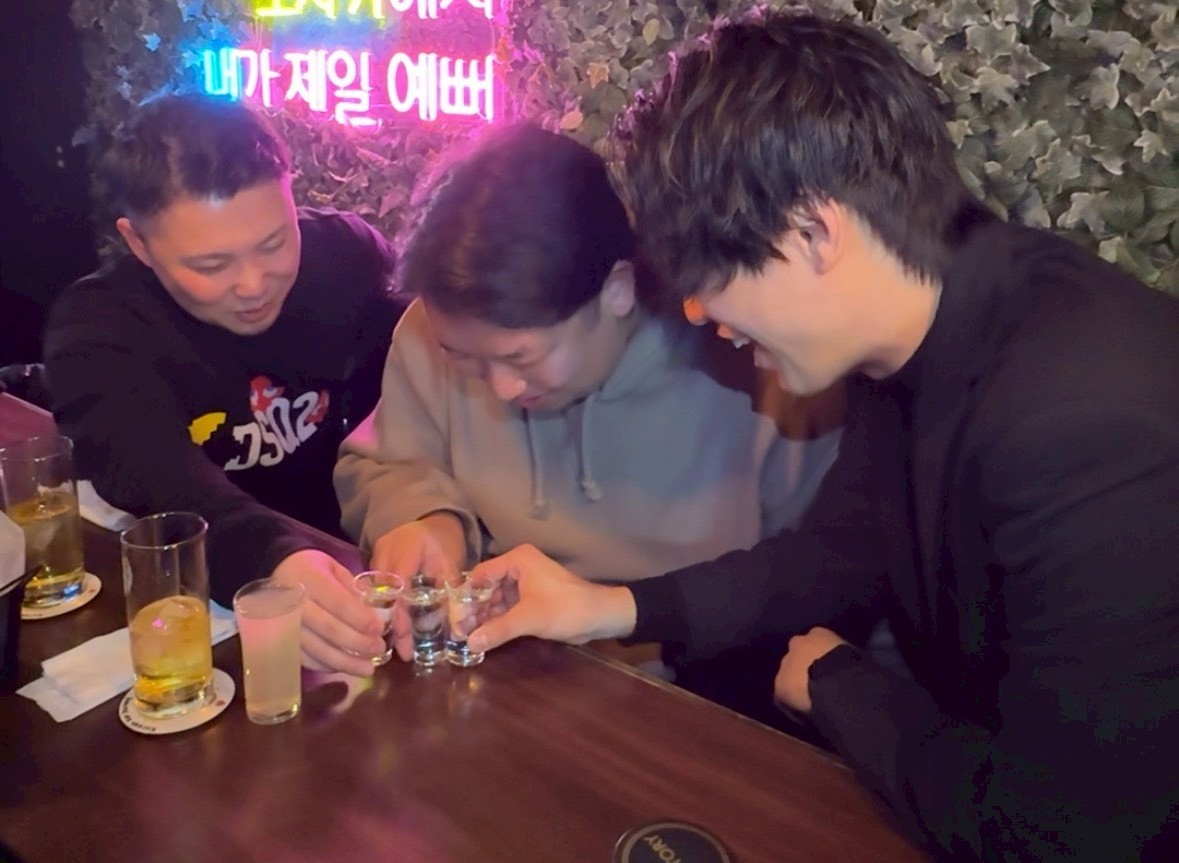
How strong is soju? About 16% ABV
The green-bottle soju you see in shops and convenience stores is about 16% ABV. That is clearly stronger than beer (about 5%), close to sake (about 15%), and weaker than Japanese shochu (about 25%). The typical ABV figures for beer, sake and shochu come from the pure-alcohol calculator page published by Hiroshima Prefecture.
Soju has become a little lighter. Korean makers Hite Jinro and Lotte Chilsung were reported to have lowered their flagship brands from 16% to 15.7% in 2026 (see the table in the next section). The ABV of a bottle in Japan depends on the brand and how it is sold, so check the label if the exact number matters.
What is the soju alcohol percentage by brand?
Only brands I could confirm are listed. Where the Korean domestic version and the version sold in Japan differ, they have separate rows. Full source URLs are in the list at the bottom.
| Brand | ABV | Where sold and notes | Source |
|---|---|---|---|
| Chamisul Fresh (green bottle, 360 ml) | 16.0% | Japan version, as shown on the Jinro Japan product page | Jinro Japan |
| Chamisul Fresh in Korea (참이슬 후레쉬) | 15.7% (was 16%) | Korean domestic version. Announced by Hite Jinro on 2 June 2026, on sale from mid-June | News report on the Hite Jinro announcement |
| Jinro (진로) | 15.7% (was 16.0%) | Korean domestic version. Announced on 12 February 2026 | News report on the Hite Jinro announcement |
| Saero (새로) | 15.7% (was 16.0%) | Korean domestic version by Lotte Chilsung. Announced 21 January 2026, shipping from 30 January | News report on the Lotte Chilsung announcement |
| Chum Churum (처음처럼) | 16% | Korean domestic version by Lotte Chilsung. As reported in July 2026 | Asiae report |
| Chamisul Original (360 ml) | 20.1% | Japan version. A higher-ABV type than Fresh | Jinro Japan |
| Chamisul fruit types (lemon, muscat, plum and others) | 13% | Japan version. Check the label for each flavor | Jinro Japan |
| Saero Omija (새로 오미자) | 12% | Korean domestic version. Fruit flavor launched in late May 2026 | News report on the Lotte Chilsung announcement |
| Chamisul Tok Tok and Chamiball (sparkling types) | 5% and 7% | Japan version. Tok Tok is 275 ml, Chamiball is 350 ml | Jinro Japan |
| JINRO 20% and 25% | 20% and 25% | Japan version. Bottles of 700 ml and larger | Jinro Japan |
The key point is that even Chamisul Fresh differs: 16.0% in Japan and 15.7% in Korea. I could not confirm whether the Japan version will change. For how soju is made, see Soju vs Sake vs Shochu, and for makgeolli see Makgeolli vs Soju.
Does soju sold in Japan have the same ABV as in Korea?
Not always. The Fresh sold in Japan is 16.0% on the Jinro Japan page, the Korean domestic one is 15.7%, and the Chamisul line in Japan runs from 5% (sparkling Tok Tok) to 20.1% (Original). Japan also sells the older-style JINRO in 20% and 25% bottles. The same brand name can mean a different ABV, so read the label.
Japanese shochu is a different category. The Hiroshima page uses about 25% as its example, and under Japan's liquor tax law continuous-still shochu must be under 36% and single-still shochu 45% or below (National Tax Agency, Sake Guide). Soju is classified separately under Korean law. If a Japanese menu says shochu, it means the Japanese drink, not soju.
Soju is meant to be served already adjusted to about 16%, chilled and poured into a small glass. Japanese shochu is often diluted with water, hot water or ice to the strength you want. So soju is one step lighter than Japanese shochu and is usually drunk without diluting.
Is soju strong compared with beer, wine, sake and vodka?
Lined up by ABV, soju is about three times beer, a little above wine, about the same as sake, and well below shochu, whisky and vodka. The figures for other drinks are general guides and vary by product.
| Drink | Typical ABV | Example serving | Pure alcohol calculation |
|---|---|---|---|
| Soju (green bottle) | 15.7 to 16% | 360 ml (one bottle) | 360 x 0.16 x 0.8 = about 46 g |
| Makgeolli | 6 to 8% | 300 ml | At 7%: 300 x 0.07 x 0.8 = about 17 g |
| Beer | About 5% | 500 ml | 500 x 0.05 x 0.8 = 20 g (the example in the health ministry document) |
| Wine | About 12% | One glass, 120 ml | 120 x 0.12 x 0.8 = about 12 g |
| Japanese sake | About 15% | 1 go (180 ml) | 180 x 0.15 x 0.8 = about 22 g |
| Japanese shochu | About 25% | 100 ml | 100 x 0.25 x 0.8 = 20 g |
| Whisky | About 40% | Single, 30 ml | 30 x 0.40 x 0.8 = about 10 g |
| Vodka | About 40% | 30 ml | 30 x 0.40 x 0.8 = about 10 g |
Is soju strong compared with beer? Yes, about three times the ABV (16% against 5%). Compared with wine, it is about four points higher, and compared with sake it is roughly level at 15 to 16%. Compared with vodka, soju is much lighter: 40% against 16% is about two and a half times.
How strong a drink feels also depends on how much you pour. Emptying a 360 ml bottle works out to more pure alcohol than two 500 ml cans of beer (40 g). Somaek (3 parts soju to 7 parts beer) comes to about 8% by calculation: (3 x 16 + 7 x 5) divided by 10 is 8.3.
How much pure alcohol is in a bottle or a glass of soju?
The formula in a Japanese health ministry document (MHLW) is volume (ml) x ABV / 100 x 0.8 (the specific gravity of alcohol). Its example is 500 ml of 5% beer: 500 x 0.05 x 0.8 = 20 g. Applied to soju, one 360 ml bottle at 16% is about 46 g, and about 45 g at 15.7%.
A 50 ml pour at 16% is 50 x 0.16 x 0.8 = 6.4 g. Glass sizes differ from bar to bar, so 50 ml is only a worked example. How drunk you get depends on your body and condition on the day, so I do not give a number of glasses.
In Japan, nobody under 20 may drink alcohol. For pouring and toasting the Korean way, see Korean Drinking Etiquette, and for the legal age and ID checks see Drinking Age in Japan Is 20.
Drinking Korean liquor at our three bars in Higashi-Shinsaibashi
Our three bars are in Higashi-Shinsaibashi 2-chome, and you can drink Korean liquor such as soju, makgeolli and somaek. Korean staff are there and K-POP is playing. This guide does not state which brands or ABV each bar serves, so please ask the Korean staff if you are curious.
| For this kind of night | Bar | What it offers |
|---|---|---|
| A lively night with a group | HEAVEN | Karaoke and darts are free to use. Smoking is allowed inside. |
| Slow drinks in a lounge | MOON | A Korean bar where you can smoke shisha in lounge seats. Karaoke is available. Smoking is allowed inside. |
| A quiet drink alone | SARANG | Mostly counter seats and fully non-smoking. No karaoke, and drinking alone is welcome. |
All three are open every day from 21:00 to 05:00 with no days off, and you can walk in without a reservation. Credit cards and cash are accepted. These are bars, so no meals are served. Nobody under 20 may enter.
HEAVEN
Karaoke, darts free to play and smoking allowed indoors; made for friends who want to sing.
5F Galaxy Building No.3, 2-4-19 Higashi-Shinsaibashi, Chuo-ku, Osaka
Open in Google MapsMOON
Shisha and lounge seats, karaoke available, smoking allowed indoors; a slow night for two.
3F LUXE Building Naka Room, 2-8-6 Higashi-Shinsaibashi, Chuo-ku, Osaka
Open in Google MapsSARANG
Quiet, fully non-smoking, mostly counter seats and no karaoke; for two, or on your own.
Room 206, Gold Center Building, 2-8-12 Higashi-Shinsaibashi, Chuo-ku, Osaka
Open in Google Maps
Questions and answers about soju ABV
Q. How strong is soju?
The classic green bottle is about 16% ABV. Chamisul Fresh sold in Japan is 16.0%, and Chamisul Fresh, Jinro and Saero in Korea became 15.7% in 2026. Fruit types are 12 to 13%.
Q. What is the ABV of Chamisul?
In Japan, Chamisul Fresh is 16.0%, Original is 20.1%, the fruit types are 13%, Tok Tok is 5% and Chamiball is 7% (Jinro Japan). The range runs from 5% to 20.1% depending on the type.
Q. Is soju strong compared with beer and wine?
Yes. At about 16% it is roughly three times the ABV of beer (about 5%) and a few points above wine (about 12%). One 360 ml bottle holds about 46 g of pure alcohol, against 20 g in a 500 ml can of beer.
Q. Is soju stronger than vodka, sake or shochu?
No for vodka and shochu, and about equal for sake. Vodka is about 40%, Japanese shochu about 25%, sake about 15%, and soju about 16%. Soju is usually drunk undiluted, so the amount you pour matters.
Q. How much alcohol is in one bottle of soju?
Use volume x ABV / 100 x 0.8. A 360 ml bottle at 16% is about 46 g, and about 45 g at 15.7%. How you feel depends on your body and condition, so drink at your own pace.
Sources (checked 24 November 2026): Jinro Japan, Chamisul product page(https://www.jinro.co.jp/goods/chamisul_360ml/index.html) / Jinro Japan, JINRO product page(https://www.jinro.co.jp/goods/jinro/index.html) / Bizwatch, 2 June 2026 (Chamisul Fresh 15.7%)(https://news.bizwatch.co.kr/article/consumer/2026/06/02/0006) / Bizwatch, 12 February 2026 (Jinro 15.7%)(https://news.bizwatch.co.kr/article/consumer/2026/02/12/0004) / Bizwatch, 21 January 2026 (Saero 15.7%)(https://news.bizwatch.co.kr/article/consumer/2026/01/21/0026) / Bizwatch, 8 July 2026 (Saero Omija 12%)(https://news.bizwatch.co.kr/article/consumer/2026/07/08/0002) / Asiae, 14 July 2026 (soju ABV round-up)(https://view.asiae.co.kr/article/2026071408440416585) / Japanese health ministry (MHLW), drinking guideline draft(https://www.mhlw.go.jp/content/12200000/001564141.pdf) / Hiroshima Prefecture, pure alcohol calculator page(https://www.pref.hiroshima.lg.jp/soshiki/57/purealcohol-calculation.html) / National Tax Agency, Sake Guide (liquor tax categories)(https://www.nta.go.jp/taxes/sake/shiori-gaikyo/shiori/2025/pdf/0009.pdf) / Absolut (example of vodka ABV)(https://www.absolut.com/en/vodka-guide/vodka-basics/understanding-vodka-alcohol-content/) / Korea Tourism Organization, VisitKorea (makgeolli)(https://english.visitkorea.or.kr/svc/contents/contentsView.do?vcontsId=231646). What I could not confirm and left out: the official sites of Hite Jinro and Lotte Chilsung would not open from my environment, so the Korean domestic ABV figures come from news reports of the two companies' announcements. I also could not confirm Lotte Chilsung products sold in Japan, the current ABV of Korean domestic Chamisul Original, or a standard soju glass size. ABV can change when a product is renewed. Beer, wine, sake, shochu, whisky, vodka and makgeolli figures are general guides and vary by product. Bar information is our own guidance.