Bars in Osaka for Foreigners:
Bar Types and How to Choose
Bars in Osaka fall into roughly six types: authentic cocktail bars, casual shot bars, pubs, jazz and music bars, standing bars, and Korean bars. They differ less in what they pour than in how loud they are, where you sit, and how you pay. So the quickest way to choose is to decide three things first: do you want quiet or lively, are you coming alone or in a group, and do you want music or conversation? Then check one practical detail before you sit down: whether the bar takes cards.
Hello. I am the Korean owner of three Korean bars in Higashi-Shinsaibashi: HEAVEN, 韓国バーMOON and SARANG. Travellers often walk in and tell us, “The last bar was so quiet I didn’t know whether I was allowed to talk,” or “A small dish arrived that I never ordered.” This page explains the types of bar you will find in Osaka and what to expect in each, so your first night out feels easy. I do not name or rank other bars here; the aim is to help you pick the kind of bar that suits your night.
.webp)
What this page covers (and what it doesn’t)
In Japan the word “bar” is narrower than you might expect. An izakaya is a Japanese-style pub where food is the centre of the evening, and a club is a place to dance. Neither is covered here; for the difference, see club, izakaya or bar in Osaka. Some places with “bar” in the name also work quite differently from a bar at home: a snack bar is a small hostess-led bar, and a girls bar is explained in girls bars in Osaka explained.
This page is about bars in the usual sense, places where drinks are the main thing, and about how to choose and walk into one. Most of the bars you will pass in Shinsaibashi, Namba and Higashi-Shinsaibashi belong to one of the six types below.
Types of bars in Osaka: a quick comparison
These are general tendencies, not fixed rules. Two bars of the same type can feel very different, so treat the table as a starting point.
| Type | What it is like | Good for | Know before you go in |
|---|---|---|---|
| Authentic bar (cocktail bar) | Mostly counter seats. A bartender mixes cocktails and pours whisky, often from a long back bar. Dim light, low music, a calm room | A quiet drink alone or for two, people who enjoy cocktails or whisky | Talk quietly, avoid loud phone calls, and ask before taking photos. If you are not sure what to order, describe what you like and let the bartender choose |
| Shot bar / casual bar | A relaxed bar where you can stop in for just one drink. Beer, highballs, simple cocktails and spirits by the glass | A first drink of the night, a quick stop between places, travellers who want something low-key | Easy to walk into. The staff often chat with guests at the counter, so it is a good first bar if you are new to Japan |
| Pub (British or Irish style) | Draught beer, sport on screens and a lively mix of locals and visitors. Closest to a bar back home for many travellers | Groups of friends, watching a match, people who want a familiar format | Many pubs work on a pay-as-you-order basis (“cash on”): you order at the counter and pay for each drink on the spot |
| Jazz bar / music bar | Records or live performances are the main attraction. Some focus on jazz, others on rock, soul or other genres | Music lovers, a slow evening listening rather than talking | On nights with live music, some bars bill differently. Ask at the door how it works before you sit down, and keep conversation low during a set |
| Standing bar (tachinomi) | No seats or very few. People drink standing at a counter for a short time, then move on | A quick drink before dinner or between bars, people who like a busy, casual room | Short stays are normal. Some ask you to pay as you order, so keep cash handy |
| Korean bar | Korean staff who talk with guests in Korean and Japanese, K-POP in the background, and Korean drinks such as soju and makgeolli | People who want conversation, K-POP fans, anyone curious about Korean drinking culture | The focus is on drinking and talking with the staff. Each bar is set up differently: some have karaoke, some are quiet, so check which kind before you go |
You will also see hotel bars, wine bars, whisky bars and bars built around a single theme. Most of them behave like an authentic bar or a casual bar, so the same tips apply. If soju and makgeolli are new to you, Soju 101 explains them.
How to choose: which bar fits your night
You want a quiet drink on your own
An authentic bar or a calm casual bar with counter seats is the natural choice. Sitting at the counter means the bartender is right there if you want to talk, and you can simply enjoy your drink if you don’t. For more ideas, see the Osaka solo drinking guide.
You want to talk with friends
A pub or a casual bar with tables works well for groups, because nobody minds a bit of noise. In an authentic bar, a group of four or more may be asked to keep the volume down, so save that for when there are only one or two of you.
You want to listen to music
Go to a jazz or music bar. Check the bar’s social media or ask at the door whether there is live music that night and how billing works on those nights.
You want to sing
In Japan, karaoke usually means a private karaoke box rather than a bar stage. If you would rather sing in a bar atmosphere with drinks and other people around, look for a bar that has karaoke equipment. See karaoke bars in Osaka.
You want to speak Korean, or meet Korean people
A Korean bar is the obvious choice. The staff are Korean, and conversation is part of the evening. See also meeting Koreans in Osaka and language exchange in Osaka.
A second stop, or a night that goes until morning
Many bars in Minami close around midnight or a little after, but some stay open until early morning. If you plan to stay out past the last train, choose your bar with its closing time in mind; see late-night bars in Osaka and after-party bars in Osaka.
Your first bar in Japan: what to expect, step by step
1. Tell the staff how many of you there are
When you walk in, hold up your fingers or say the number (“two, please” is fine). Wait to be shown to a seat rather than picking one yourself. In small bars, the counter is often the default seat for one or two people.
2. Order your first drink
If there is no menu, or you can’t read it, that is completely normal. Tell the bartender what you like: “something sweet,” “not too strong,” “gin-based,” “a whisky I can drink neat”. Leaving the choice to the bartender (omakase) is common in Japan and often leads to the best drink of the night. If you want to know what something will cost before it is made, just ask; nobody will think it strange.
3. A small dish you didn’t order? That may be the otoshi
At some bars, a small snack arrives with your first drink even though you did not ask for it. This is called otoshi, and it usually appears on the bill. It is a custom, not a mistake or a trick. But whether a bar serves it, and how it is billed, differs from bar to bar, so if you want to know, ask when you order your first drink: “How does the bill work here?” Asking politely is normal, and a good bar will explain it clearly.
4. Quiet-bar manners
In an authentic or jazz bar, the room itself is part of what people come for. Speak at a normal, low volume, step outside for phone calls, and ask before taking photos of the bar, the bottles or other guests. Wearing strong perfume or cologne to a whisky bar is also best avoided. None of this applies as strictly in a pub or a lively bar; read the room.
5. How you pay: at your seat or as you order
There are two common systems. In most bars you pay at the end: ask for the bill (“okaikei onegaishimasu”, or just make a small X with your index fingers) and pay at your seat or at the register. In pubs and standing bars you often pay for each drink when you order it. If you are not sure which one you are in, watch what the people around you do, or ask. Tipping is not part of bar culture in Japan, so you don’t need to leave anything extra.
6. Cash or card: check before you order
Cards are widely accepted in Osaka, but some smaller bars still take cash only. Look for card logos at the entrance, or simply ask “Can I pay by card?” before your first drink. Carrying some cash on a night out saves trouble. Before paying by card, always check the amount on the bill.
7. You must be 20 to drink
The legal drinking age in Japan is 20, whatever the rule is in your own country. Bars may ask for ID, so carry your passport or a copy.
8. Plan how you will get home
Trains in Osaka stop running around midnight. Check the last train for your line in a route app before you start drinking, or decide in advance to take a taxi or stay out until the first train. More tips are in Osaka bar etiquette and the Osaka nightlife safety guide.
One more thing: choose your bar yourself, and do not follow someone on the street who offers to take you to one. In Minami, street touting is banned by city ordinance. See Osaka nightlife scams and touts.
About our bars: three Korean bars, each for a different night
If a Korean bar sounds like your kind of night, here is what you can check about ours before you come. They are one option among many types of bar in Osaka.
- All three (HEAVEN, 韓国バーMOON and SARANG) are Korean bars where you drink and talk with Korean staff in Korean or Japanese. Coming alone is fine.
- All three are bars, not Korean restaurants, and do not serve food. Eat before you come.
- Open every day, 21:00 to 05:00, no closing day, no reservation needed. You can ask questions by phone or Instagram DM before you come.
- Credit cards and cash are both accepted.
- Smoking is allowed inside HEAVEN and 韓国バーMOON. SARANG is fully non-smoking.
- Google Maps reviews: HEAVEN 2,844, 韓国バーMOON 380 and SARANG 678, each rated 4.9 (as of September 2026).
- The legal drinking age in Japan is 20; guests under 20 cannot enter.
All three are in Higashi-Shinsaibashi 2-chome, within a five-minute walk of each other. For directions, see getting to Higashi-Shinsaibashi.
Which of our three bars fits your night?
| Your night | Bar | Why |
|---|---|---|
| Sing with friends and keep the energy up | HEAVEN | Free karaoke and darts, plus a VIP room for groups on their second or third stop |
| Sit down and talk for a long time | 韓国バーMOON | Shisha and lounge seats, for a long conversation with the people you came with |
| A quiet drink, or a bar that is easy to walk into alone | SARANG | A quiet bar, fully non-smoking, with no karaoke; mostly counter seats, so coming alone is easy |
For a side-by-side look at the three, see which Korean bar in Osaka or the quick guide by purpose. For shisha, see shisha in Osaka.
HEAVEN
Free karaoke and darts. For a night of singing with friends.
5F Galaxy Building No.3, 2-4-19 Higashi-Shinsaibashi, Chuo-ku, Osaka
Open in Google MapsMOON
A Korean bar with shisha and lounge seats. For sitting down and talking.
3F LUXE Building Naka Room, 2-8-6 Higashi-Shinsaibashi, Chuo-ku, Osaka
Open in Google MapsSARANG
A quiet, fully non-smoking bar with no karaoke. Mostly counter seats, easy to visit alone.
Room 206, Gold Center Building, 2-8-12 Higashi-Shinsaibashi, Chuo-ku, Osaka
Open in Google Maps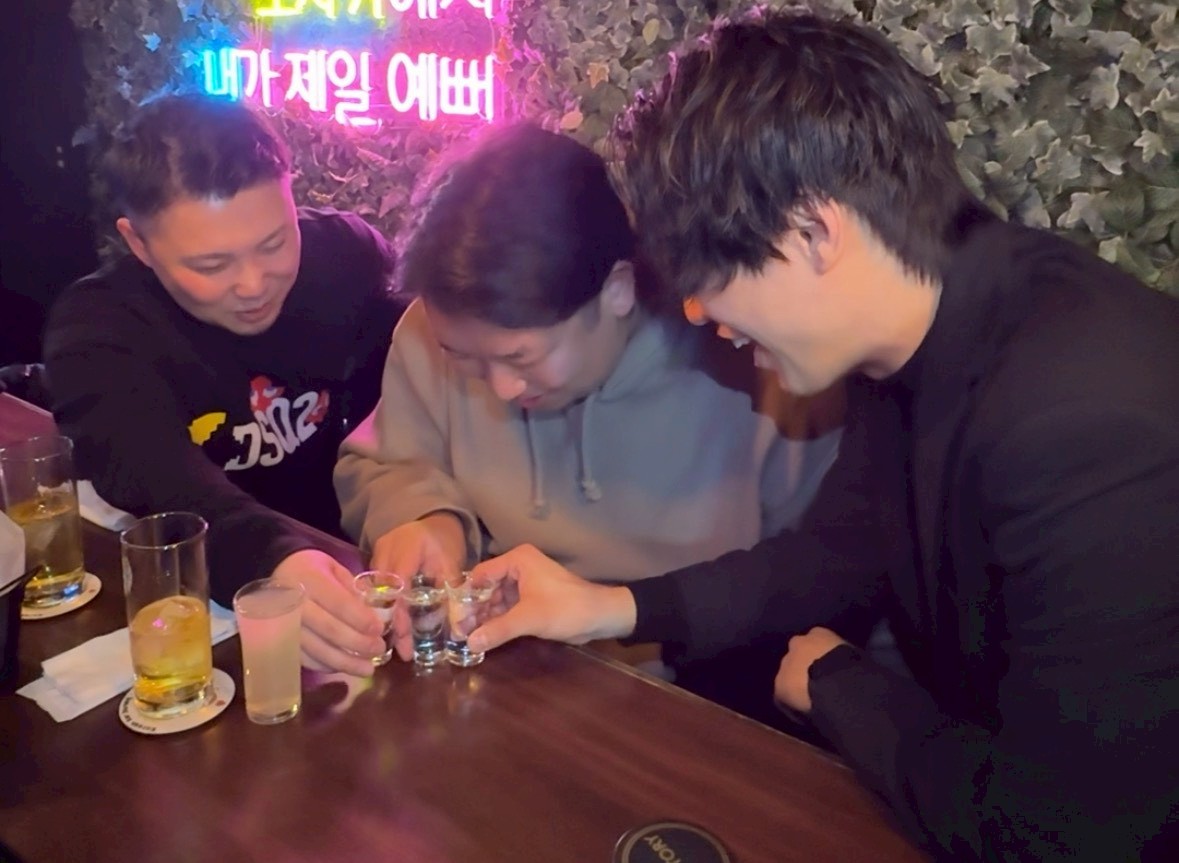
FAQ
Q. What is an authentic bar in Japan?
An authentic bar is a classic cocktail and whisky bar built around a counter, where a bartender makes each drink in front of you. The room is usually dim and quiet, so guests talk at a low volume. If you are unsure what to order, tell the bartender what you like and let them choose.
Q. Are bars in Osaka foreigner-friendly?
Most bars in Shinsaibashi and Namba are used to overseas visitors, and pubs and casual bars are especially easy to walk into. Small authentic bars may have fewer seats and a quieter atmosphere, but you are welcome as long as you follow the room’s pace. A translation app helps if the staff speak little English.
Q. Can I go to a bar alone in Osaka?
Yes. Drinking alone at the counter is completely normal in Japan, especially at authentic and casual bars. Among our bars, SARANG is a quiet, fully non-smoking bar with no karaoke and mostly counter seats, so it is easy to visit alone.
Q. I got a small dish I didn’t order. Do I have to pay for it?
That dish is called otoshi, a custom at some bars and izakaya, and it usually appears on the bill. Whether a bar serves it, and how it is billed, differs from bar to bar, so if you want to know, ask when you order your first drink.
Q. Do bars in Japan take credit cards?
Many do, but some smaller bars are cash only. Check the logos at the entrance or ask before you order. All three of our bars accept both cards and cash.
Q. It’s my first time at a bar in Japan. Will I be OK?
Yes. Tell the staff how many of you there are, wait to be seated, and order by describing what you like. Ask how the bill works if you are unsure, and check whether the bar takes cards. That covers almost everything.
Q. Which bars in Osaka are open until morning?
Many bars in Minami close around midnight, but some stay open until early morning, so check the closing time before you go. Our three bars are open every day from 21:00 to 05:00, with no closing day and no reservation needed.
Q. Do your bars serve food?
No. All three are bars, not Korean restaurants, and do not serve food, so eat before you come. Guests under 20 cannot enter.