Osaka Nightlife Scams
How to avoid touts and overcharging in Minami
A tout is someone who approaches strangers on the street and tries to steer them into a particular bar. Overcharging (bottakuri in Japanese) is being handed a bill that bears no relation to what you were told before you walked in. Osaka City has designated the Minami district, including Shinsaibashi, Soemoncho, Dotonbori and Namba, a tout-free zone, so street solicitation there breaks a city ordinance whatever the type of business. Avoiding trouble comes down to three habits: never follow anyone who approaches you, look the bar up on Google Maps before you enter, and ask how the charges work before you order.
Hello. I am Korean and I run three Korean bars in Higashi-Shinsaibashi (HEAVEN, 韓国バーMOON and SARANG). To be clear from the start: our three bars are bars, not girls' bars, hostess clubs or nightclubs. Running a bar in this district every night, I hear the same two stories from guests: “someone stopped me on the street just now” and “the bill at the last place was a shock”. This page puts those stories in order using only what Osaka City, Osaka Prefecture, the Osaka Prefectural Police and Japan's Consumer Affairs Agency publish. No forum posts, no personal anecdotes from blogs. For general night-time safety in Osaka (trains, taxis, your drink), see our Osaka nightlife safety guide; this page is only about touts and bills.
.png)
What touting and overcharging mean — as the ordinances define them
Osaka City's Ordinance on the Appropriateness of Customer Solicitation (大阪市客引き行為等の適正化に関する条例) groups three things together as “solicitation and related acts”:
- Touting: actively inviting a particular person, picked out from passers-by, to become a customer of a business
- Recruiting: actively inviting someone to take up work (scouting)
- Waiting to tout: loitering, standing around or hanging about in a place for the purpose of touting or recruiting
“Bottakuri”, on the other hand, is slang, not a legal term. Osaka Prefecture's ordinance (the ordinance on preventing unfair solicitation and unfair collection of charges at businesses serving alcohol, usually called the anti-rip-off ordinance) bans soliciting customers with false statements about charges, or statements that make charges seem far lower than they are, and collecting charges by intimidating people, surrounding them or otherwise making them feel unsafe. When those two things happen together, people call it bottakuri.
One thing deserves emphasis: the bar a street tout leads you to and the bars of Minami as a whole are not the same thing. Most places in Shinsaibashi and Namba are ordinary bars that you find by their sign and Google Maps and walk into yourself. The problem is how you choose a bar, not the district and not any particular kind of business.
Osaka City's ordinance — Minami is a tout-free zone
On 27 October 2014 Osaka City designated the Kita and Minami districts as priority areas and tout-free zones under the ordinance, and on 2 February 2019 it re-designated the tout-free zones in Kita and Minami. Inside a tout-free zone, solicitation is banned regardless of the type of business. Anyone who ignores guidance, a recommendation and then an order faces a non-penal fine (an administrative monetary sanction), and the city may publish the offender's name and address or the name of the establishment. From 1 April 2021 the procedure leading to the fine was shortened, and since April 2024 the city has deployed patrol staff in the entertainment districts.
In other words, anyone inside the zone telling you “I know a great bar” is already breaking the ordinance.
Whoever they are, do not answer, and keep walking towards the bright, busy main streets (Shinsaibashi-suji, Midosuji). That is the whole technique.
The city's contact point for the ordinance is the Citizens' Bureau, Community Safety Section (06-6208-7317). The exact boundaries of the zone are on the city's official map (sources at the end of this page).
Osaka Prefecture's ordinance — posted charges, and no unfair solicitation or collection
The prefectural anti-rip-off ordinance (enacted 2001; the latest amendment took effect on 24 October 2025) applies to bars, taverns and any other establishment, whatever it calls itself, that serves alcohol and entertains customers in a convivial atmosphere, within areas set by the Public Safety Commission. The Osaka Prefectural Police, Minami Police Station states on its website that Minami is an area where this ordinance applies, and that unfair solicitation and unfair collection of charges are prohibited there.
| What the ordinance requires of an operator | Summary, following the wording of the official text |
|---|---|
| Display of charges | Charges must be displayed on the premises where customers can see them easily |
| No false advertising | Advertising must not state anything false about charges, or anything that makes them seem far lower than they are |
| No unfair solicitation | No false statements about charges; no calling out or handing out flyers while following someone; no continuing to solicit a person who has refused |
| No unfair collection | When collecting charges, no intimidation, surrounding a person or other behaviour that makes them feel threatened or uneasy |
Read the other way round: no charges displayed anywhere, someone following you saying “it's cheap”, someone who will not leave after you say no — any one of those means you are close to exactly what the ordinance prohibits.
The scam the Minami Police Station is warning about
The Osaka Prefectural Police, Minami Police Station, which covers the district, has a page titled “Watch out for bottakuri”. It warns that people are being talked into restaurants and bars through matching apps and then handed very large bills, and describes two patterns.
- Someone you met on an app says “let's go to a place I know”. Before going in you are told it is a flat-rate drinks deal; at the till the bill is in a different league altogether. Paying by credit card, you later find a charge on your statement from a business you do not recognise.
- In the bar you are made to play a game where the loser downs a shot. The bill is huge, and only afterwards do you notice the small print on the menu: shots are charged separately.
The police station's advice is two lines long: check how the charges work, and check the amount before paying by credit card. The Minami Police Station is at 1-5-26 Higashi-Shinsaibashi (06-6281-1234), just north of our bars in Higashi-Shinsaibashi 2-chome.
The point of this pattern is that it is not a street tout at all: it is someone you have just met choosing the venue. Nobody stops you on the street, but the moment you let another person decide where you drink, the structure is the same. Pick the bar yourself, look it up yourself, then walk in. That is the basic rule for a night in Minami.
Five ways to stay out of trouble
1. Do not follow anyone who approaches you on the street
Inside the tout-free zone, touting itself breaks the ordinance. “I'll just show you the way” and “it's right here” change nothing. Do not answer; keep walking towards Shinsaibashi-suji or Midosuji. If someone will not leave you alone, go into the nearest koban (police box).
2. Search the bar's name on Google Maps before you go in
Type the name on the sign into Google Maps and look at the number of reviews, the rating, the opening hours and the interior photos. A bar with hundreds of reviews and a long history has been walked into and rated by a great many people. A bar whose name does not come up, or that has no photos and no opening hours, has just given you a reason to keep walking.
3. Ask how the charges work before you order
Before your first drink, ask whether there is a seating charge or otoshi (a small compulsory appetiser), whether the bar charges by time, and what triggers extra charges. The prefectural ordinance obliges operators to display their charges, so a bar that cannot answer, or displays nothing anywhere, is one to avoid. If you are offered a flat-rate drinks deal, ask exactly what is included and what is not. Otoshi, seating charges and the rest of Japan's bar customs are explained in our Osaka bar etiquette guide.
4. Read the bill before you pay, and check the amount before you tap your card
As the police station says, check the figure on the terminal before you approve a card payment. If there is an item on the bill nobody explained, ask what it is before paying.
5. Save the numbers before you go out
| Situation | Number | Notes |
|---|---|---|
| Threatened, surrounded, or not allowed to leave | 110 (police) | From where you are. Minami Police Station: 1-5-26 Higashi-Shinsaibashi (06-6281-1234) |
| Help in English, Chinese or Korean, 24 hours | 050-3816-2787 | Japan Visitor Hotline, run by the Japan National Tourism Organization (JNTO). Emergencies and general assistance, 24 hours a day, 365 days a year |
| A consumer dispute about a bill (also after you have paid) | 188 | Japan's consumer hotline, operated by the Consumer Affairs Agency; connects you to the nearest consumer affairs centre. Japanese-language |
| Your own country's consulate | Consulate-General in Osaka | Many countries have a consulate-general in Osaka; check its official website for the emergency line |
Japan's National Consumer Affairs Center advises that if you were intimidated into paying, you should report it to the police promptly, and that if you paid by card you should also tell the card company. Even after you have paid, it is worth calling 110 and the hotline.
About our bars — the things you can check before you walk in
You will want to ask “and what about your bars?”, so here are only the facts you can verify from outside.
- Our three bars (HEAVEN, 韓国バーMOON and SARANG) are bars, not girls' bars, hostess clubs or nightclubs.
- Each one is listed on Google Maps with public reviews. HEAVEN has 2,844 reviews, MOON (listed as 韓国バーMOON) 380 and SARANG 678, all rated 4.9 (September 2026). Search the name and you can read the reviews and see the interior before you come.
- Open 21:00–05:00 every day, no closing day, no reservation needed. The hours are on Google Maps and on this site.
- You can contact us before visiting, by phone or Instagram DM. If anything is unclear, ask before you come in.
- Credit cards and cash are both accepted.
- Smoking is allowed inside HEAVEN and 韓国バーMOON. SARANG is fully non-smoking.
- Private hire and groups are welcome (ask the bar about numbers).
- Staff are Korean and speak Japanese; simple English and translation apps work fine. Guests must be 20 or older.
To choose between the three, see which Korean bar is right for you or the quick guide by purpose. If Korean bars are new to you, start with what is a Korean bar?, and for how they differ from snack bars and hostess clubs, the Japanese snack bar guide.
So what kind of night can you have? Three bars by purpose
It would be a shame if “avoid the touts” were the whole of your night in Minami, so here is what an evening at our bars looks like. All three are in Higashi-Shinsaibashi 2-chome, within five minutes' walk of each other. All three are bars, not Korean restaurants, and we do not serve food.
| The night you want | Bar | Why |
|---|---|---|
| Sing and keep the energy up | HEAVEN | Free karaoke and darts, plus a VIP room for groups on their second or third stop |
| Sit down and talk for a long time | 韓国バーMOON | Lounge seats and a shisha, for a slow evening |
| A quiet drink, or you are on your own | SARANG | A quiet bar, fully non-smoking, with no karaoke; mostly counter seats, so coming alone is normal |
For bars where turning up alone is normal, see drinking alone in Osaka; for women travelling alone or together, Osaka bars for women; and for the difference between a club, an izakaya and a bar, club, izakaya or bar?.
HEAVEN
Free karaoke and darts — for a night that ends with singing.
5F Galaxy Building No.3, 2-4-19 Higashi-Shinsaibashi, Chuo-ku, Osaka
Open in Google MapsMOON
A Korean bar with shisha and lounge seats, for sitting and talking.
3F LUXE Building Naka Room, 2-8-6 Higashi-Shinsaibashi, Chuo-ku, Osaka
Open in Google MapsSARANG
Quiet, fully non-smoking, no karaoke. Mostly counter seats; coming alone is normal.
Room 206, Gold Center Building, 2-8-12 Higashi-Shinsaibashi, Chuo-ku, Osaka
Open in Google Maps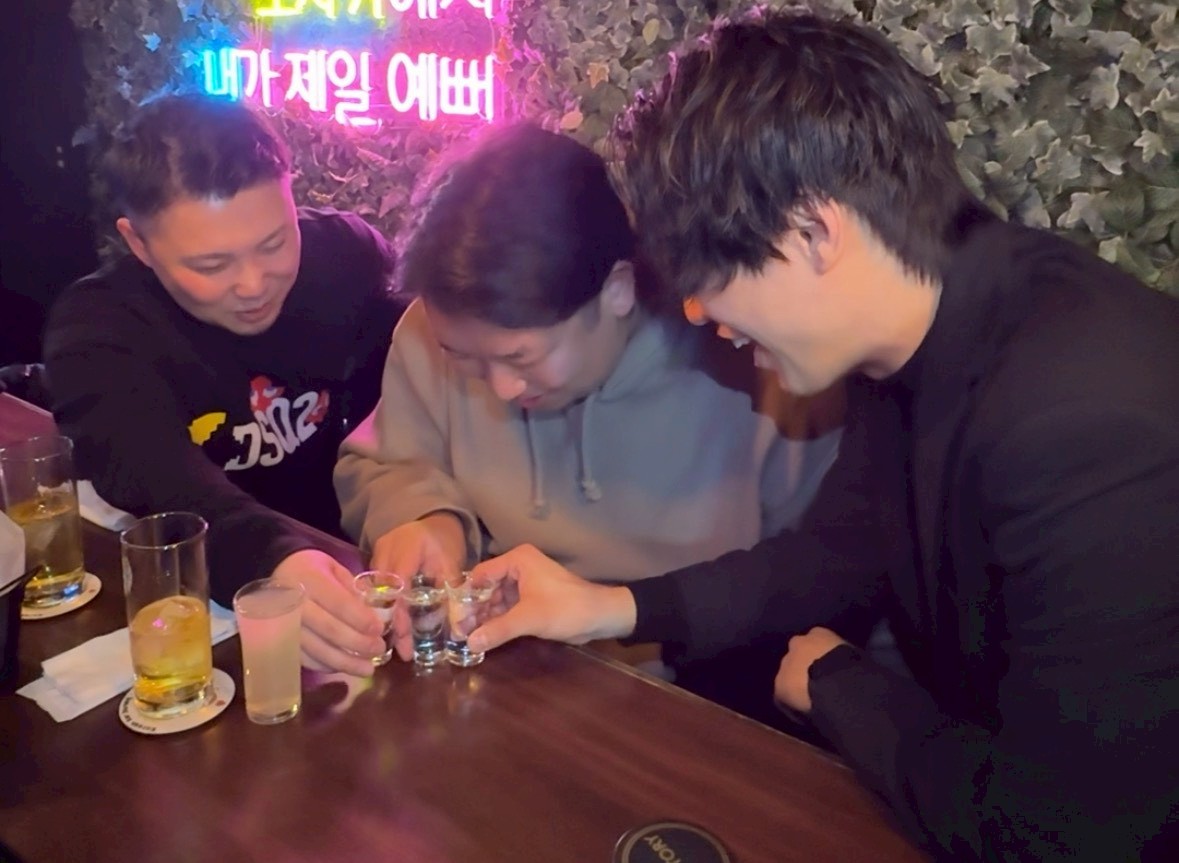
FAQ
Q. What is a tout?
Someone who approaches passers-by on the street and actively invites them to become customers of a particular business. Osaka City's ordinance groups touting, recruiting (scouting) and waiting to tout together, and bans all of them, regardless of the type of business, in the tout-free zones of Minami and Kita.
Q. What does bottakuri mean?
It is Japanese slang, not a legal term, for being handed a bill far larger than anything you were told before entering. Osaka Prefecture's ordinance bans soliciting customers with false statements about charges and collecting charges through intimidation or behaviour that makes people feel unsafe, and the Minami Police Station states that Minami is an area where the ordinance applies.
Q. Someone approached me in Dotonbori. What should I do?
Do not answer, and keep walking towards the bright, busy main streets. Inside the tout-free zone, touting itself breaks the ordinance, so there is no reason to follow whatever they say. If they persist, go into the nearest koban. Choose the bar yourself and check its name on Google Maps before you go in.
Q. I was handed a huge bill. What now?
Ask for a breakdown first. If you are threatened or surrounded, call 110. For help in English, Chinese or Korean, the Japan Visitor Hotline (050-3816-2787) is available 24 hours a day. You can still report it after paying, and if you paid by card, Japan's National Consumer Affairs Center advises telling the card company as well.
Q. Someone I met on a matching app wants to take me to a bar. Is that safe?
The Minami Police Station warns that people met through apps are steering others into venues that then present very large bills. If you go, choose the bar yourself, check it on Google Maps, ask how the charges work before ordering, and check the amount before approving any card payment.
Q. Are HEAVEN, MOON and SARANG girls' bars or hostess clubs?
No. All three are bars, not girls' bars, hostess clubs or nightclubs. Each is listed on Google Maps with public reviews (2,844, 380 and 678 reviews respectively, all rated 4.9, September 2026), so you can check before you come. Open 21:00–05:00 daily, no reservation needed, and you can contact us by phone or Instagram DM before visiting.
Q. Is there a quiet bar where I can drink on my own?
Yes. SARANG is a quiet, fully non-smoking Korean bar with no karaoke and mostly counter seats, so coming alone is completely normal. Open 21:00–05:00 daily, no reservation needed.
Q. Can I find out how the charges work before I come?
Ask us by phone or Instagram DM before you visit. The prefectural ordinance obliges operators to display their charges, so at any bar in Osaka it is sensible to ask how the charges work before you order.
Q. Can I eat at the Korean bars?
No. All three are bars, not Korean restaurants, and no food is served. Eat nearby first, then come for a drink. Guests must be 20 or older.
Sources (all checked 30 September 2026): Osaka City, “Outline of the Ordinance on the Appropriateness of Customer Solicitation” and “Status of Measures under the Ordinance” (Citizens' Bureau, Community Safety Section); Osaka Prefecture, “Ordinance on Preventing Unfair Solicitation and Unfair Collection of Charges at Businesses Serving Alcohol” (prefectural ordinance database); Osaka Prefectural Police, Minami Police Station, “Watch out for bottakuri”; Consumer Affairs Agency, “Consumer Hotline 188”; National Consumer Affairs Center of Japan, consumer trouble FAQ; Japan National Tourism Organization (JNTO), “Japan Visitor Hotline”. The ordinances are summarised following the wording of the official pages, without legal interpretation; zone boundaries and ordinances can change, so check the official pages for the latest text. Details of our bars are as displayed on Google Maps in September 2026.